
moving on: http://airaid.tumblr.com/
making a commitment to write more regularly on my new blog.
many thanks for reading.
20.12.12


22.12.11
the party & the afterparty
Review: The Weeknd - Echoes of Silence

Why not review an album hours after its release? Things move fast now, hype is warp-speed, so best enjoy it while its fresh. And aren't The Weeknd the most befitting subject for this kind of reaction? Abel Tesfaye's project feeds off the buzz, hate, love, etc. generated by the same dispersed online audience that he has offered up his immaculately produced, beautifully executed mixtapes to all year, and all void of a discourse save for Tesfaye's undeniably shitty Twitter account - Weeknd albums come to us as clean as the sound itself, shorn of any critical and promotional baggage - but one that is soon after filled in by amalgamation of all those little moments of reaction that his collective audience of critics and listeners (and it seems like a good chunk of these listeners are critics) have felt and expressed.
And if general opinion is anything to go by, it's that general opinion is The Weeknd is amazing - various year-end lists with House of Balloons somewhere near the top have commented that Tesfaye's was the sound that united highly diverse and otherwise antagonistic listening groups in 2011. I feel like this kind of claim needs empirical evidence - insane blog and Twitter hype doesn't count, given as a fairly specific group of listeners are the ones producing this chatter. But I'll give in to intuition and say, yes, basically anyone who loves music will find something to like or even love in The Weeknd. And for free! And lots of it. Three mixtape albums in a year - and sure, whilst admittedly there's been signs of diminishing returns throughout this 'balloon trilogy', in isolation, anyone of these three would be more than enough to recognise that here is a prodigous, precocious talent.
What anyone will also find in these three albums, if they care to listen, is I think a subtly executed but also oddly engrossing narrative, a tragic story of excess and its shadows. In this regard, if House of Balloons was the courtship - Tesfaye oiling us up with his debased but undeniably exciting ways - and Thursday was the party itself, then Echoes of Silence is the comedown, the morning after where you put some Sade on the stereo and nursing your heavy head, think about all the fucked up things you did and how your girl fucked you over last night and wonder about how soon you're going to do it all again. Each album in the trilogy has, somewhat amazingly, achieved its own specific aesthetic - from the alternating ecstasy-soaked epics and late-night slow-jams of his debut, to Thursday's faux-rock histrionics, and now Echoes of Silence, with its far more sombre tone, each song a kind of holding-pattern ("the same old song", as he sings on the track of the same name, that maybe "you don't wanna sing no more" as he admits on 'XO / The Host') of not necessarily great emotions - jealously, regret and loneliness chief among them.
The album opens with a cover of Michael Jackson's 'Dirty Diana' - an explicit acknowledgement not only of the influence MJ's vocal style seems to have had on Tesfaye (there's a couple of seconds where the two are indistinguishable) but also of Jackson's tortured, existential romanticism that he perfected in songs like this and 'Smooth Criminal'. Later, on 'Outside' he's letting a girl use the same positions she liked with her ex as he tries convincing himself that it'll be okay once he's inside her and that he's the one she wants. Bitterness, jealously, the lovelorn run-off of one-night-stands - the dull glow of heartache pervades the atmospheres of Echoes of Silence, even if Tesfaye tries convincing himself otherwise, that he "ain't scared of the fall". The other side of the coin, the feeling of waking up. The balloon has been popped.
What has unified The Weeknd's trilogy, apart from Illangelo and Doc McKinney's uniformly amazing avant-R&B production, is Tesfaye's ultra-seedy spin on the typical sex and drug signifiers of the genre, taking them into their most debauched and perverted extremes until something like a crypto-Surrealism is reached. I'm not talking the melting clocks and quirky styrups saccharine of a Dali, nah uh - what we're dealing with here is pop's version of Bataille's renegade surrealism - the kind of works which in the words of Adrian Martin "enact a bleak politics of surrealist transgression - a tearing open of bodies, and a voyage of no return into furiously alienated minds". I don't think I'm drawing a long bow here when I say that listening to The Weeknd is basically the sonic equivalent of Hans Bellmer's La Poupée series - a never-ending parade of fucked up bodies contorted through the sickening haze of the coke-gaze.
That's why 'Initiation' is both an apt and an odd track on this fairly introspective album - well, let's say, even more instropective than usual. At the pivotal point of the album, it's basically the epitome and let's also say the exhaustion point of the fucked-up-party-surrealism that Tesfaye has been developing. As the music trips from left-to-right channel, creating a sense of woozy, giddying disorientation, the narrator creepily, softly croons to a girl that she "can have it all" (his attention, affection, that is) only if she passes his "test": "to meet my boys" - now there's conjecture around the traps as to what the 'boys' Tesfaye is referring to here actually are. Is he - echoing the slightly creepy mention of "light-skinned girls, first flight from Poland" on his guest verse for Drake's 'Crew Love' - basically talking about a gang-bang? Or is he saying that, as the rest of the lyrics would suggest, that if she wants to get down, she has to be introduced to and imbibe all the various drugs that will cause the kind of vocal effects we hear throughout the song, constantly warping and winding their way up and down in pitch and speed:
Got you drinking out them white cups. Sodas. All this shit sound foreign to you. Thick smoke. Choking. Babygetfamilliarwiththeorderjustcrackitthenpouritthensipslowthentiplowmyeyesredbut mybrimlow that x o
But really, I don't think whether it's his boys or his 'boys' that Tesfaye is really referring to is the point here, it's the fact that he's fucked up enough to make this highly ambiguous comparison in the first place. The gang-bang-as-bunch-of-drugs-as-gang-bang extended analogy perfectly dilates The Weeknd's wider sketch of a hedonism that understands no moral or material bounds, where every night is a party and every orifice is a receptacle for drugs and/or genitalia, take your pick.
But there has to be consequences right? Smack bang in the middle of the album, 'Initiation' is the debauchery that surrounds the dawning sense of consequence and alienation that might be the ultimate byproduct of the kind of lifestyle House of Balloons and Thursday introduced us to. Girlfriends go missing, things go quiet, parties always end. Echoes of Silence really is a fitting conclusion to all this unbridled hedonism, and poses the question that everyone puts off thinking about whilst the good times are rolling - what's going to happen once it all comes to an end? What do I do then? And who will I have left?
I like the thrillNothing's gonna make me feel this realSo baby don't go homeI don't wanna spend tonight aloneBaby please, would you end your night with me?Don't you leave me all behind-- 'Echoes of Silence'
14.12.11
dope as dark
In lieu of a 2011 review, I just want to say a little bit about how amazing hip-hop and R&B have been this year. Mixtape with some of tracks mentioned throughout is below.
These genres have always been musically promiscuous, hustling beats, samples and hooks from anywhere their producers can find them, but 2011 marks a year in which the boundaries truly exploded, where much of this music found itself drawing from the fringes and ending up in some bizarre and thrilling limbo between commercial boom-bap and truly outré esoterica, both and neither at the same time. This isn't the willed abstraction of a Shabazz Palaces or Antipop Consortium, hip-hop for thinking men, but neither is it outright chart-chasing rinse. Instead, this is music dripped in a thick haze of experimentation and sonic adventurousness that always keeps one eye on a listenable, rappable beat and structure. The result is something both immediately accessible - laced with gripping hooks and beats - and continually beguiling, ever deeper. At the core of this music is the way in which raps just melt into the lush, hazy productions in a way that's about ambience and atmosphere as much as the traditional concerns of beat and rhyme.
There are a number of directions this thing has gone, and here I'm thinking about the more languid stuff that some have labelled 'cloud rap' - basically hip-hop's night bus or chillwave - which shares the same trashy, lo-fi aesthetic of Dipset trance but dials down the mood and pace, dripping plastic. That's why, unfortunately, I don't really have room in this piece for Araabmuzik - a dude whose MPC detournements of commercial trance music I've written about previously - despite the fact that he perhaps epitomises the paradox of epic roughness that I'm trying to get at here, where constant reminders that 'You are now listening to Araabmuzik' would leave you thinking you were listening to a hastily cut demo CD if every song on Electronic Dream didn't also sound like stars exploding. Nevermind, though, because the final word on Araabmuzik comes from the man himself: all you need to read are the choice quotes collected on his last.fm bio, nam sayin'.
Anyway, the woozy aura of the hip-hop and R&B I'm thinking about centres around two poles. First, there's the 'based' sounds of Clams Casino, who typifies the duality of this stuff in that he produced beats for Soulja Boy whilst also releasing an EP on witch-house/drag label Tri Angle this year. He also did hazed-out work with dollar-sign rapper A$AP Rocky for the ground-shattering opening tracks of his LiveLoveA$AP and later track 'Leaf', which also features associates Main Attrakionz (released also on their 808s & Dark Grapes as 'Take 1'), the prime members of the prolific Green Ova Underground crew, whose swamped out, psychedelic indie-rap is another major touchstone here. Clams' Instrumental Mixtape collects various base(d) tracks he has made for Lil B, Soulja Boy, etc. and given their own room to breathe, the spectral aesthetic of his work emerges fully-formed as a singular, atmospheric take on electronic production.
Then you've got the Canadian contingent, the OVOXO - Drake, The Weeknd and all the implausibly and consistently amazing Toronto knob twiddlers in their crew: McKinney, Illangelo, Zodiac, Boy-1Da and Noah '40' Shebib. Whilst the styles are distinct here, much of this stuff revolves around a less swampy, more immaculate down-tempo, ambient vibe marked by sexy synth and keys. This late-night slow-jam style is switched up with the occassional epic like 'Headlines' or 'Lonely Star'.
Both these poles emphasise different elements of the new vibe - call it the cannabis-cocaine continuum - but there's two things that, at the risk of sounding glib, they both have in common: drugs and computers. Whether it's the psychotropic cloud of Clams and co. or the uppers, downers and coke-addled cornucopia of The Weeknd, this music seems to almost literally attempt to transubstantiate the experience of getting high, tripping, etc. into musical form. Rap has always done this, sure, but there's more of a willingness now to musically and lyrically explore the darker parts of these vices, the weird places they take you to and the bizarre sounds they can produce. The Weeknd epitomises this - whether it's all a ploy or not is up for debate, but a track like 'Initiation', with its chopped-and-screwed vocals, is basically designed to sound out the experience of taking a pharmacy aisle's worth of drugs which, not coincidentally, Abel Tesfaye is singing about - the warped up and down pace of the vocal pretty much perfectly approximates the shift from the dissociative drowse of lean to the hyped-up gloss of coke. Elsewhere, in a beautiful turn of phrase, Colin McGowan says the music of the Green Ova crew "sounds like an anthropomorphic freezer bag full of narcotics eating itself—one moment commingling with the clouds, the next neck-deep in a swamp thick as glue".
Then there's the internet. As I said, rap has always feasted on the fruits of sounds it has cherry-picked far and wide, but there has never been as much exposure to 'outside' as much as there is today, in a way that has made hip-hop and R&B the premiere exponent of the 'miscegenation' that Sasha Frere-Jone's so longed for a few years back when he surveyed the white-washed world of indie rock. Only the funny thing now is that 'black' music is borrowing liberally from genres and subcultures traditionally seen as white - from Danny Brown's hipster-thin jeans to Main Attrakionz sample of ethereal pop outfit Glasser on 'Bossalinis and Fooliyones Pt. 2'. There's a parallel story here about white producers and black rappers - peep Clams Casino and his clientele - but the fact these artists are coming together signals just the kind of utopian 'smelting pot' someone like Emerson held out hope for and, what's more, for once it's white people in the background.
One thing driving this explosion of sounds and influences is the networked digital, in two ways - the first is that these producers are have grown up punching out beats on a laptop in their bedrooms and flinging them out through the ether via self-maintained Tumblrs or even just Mediafire links - the concept of physical releases and actual studios is largely alien to them. All that's needed is a cheap computer and some $250 Fruity Loops software, and with that an openness to different production and distribution styles, and these producers have found ways of not just approaching but eclipsing the 'digital maximalism' of recent electronica that Simon Reynolds has recently passed ambivalent comment on:
These genres have always been musically promiscuous, hustling beats, samples and hooks from anywhere their producers can find them, but 2011 marks a year in which the boundaries truly exploded, where much of this music found itself drawing from the fringes and ending up in some bizarre and thrilling limbo between commercial boom-bap and truly outré esoterica, both and neither at the same time. This isn't the willed abstraction of a Shabazz Palaces or Antipop Consortium, hip-hop for thinking men, but neither is it outright chart-chasing rinse. Instead, this is music dripped in a thick haze of experimentation and sonic adventurousness that always keeps one eye on a listenable, rappable beat and structure. The result is something both immediately accessible - laced with gripping hooks and beats - and continually beguiling, ever deeper. At the core of this music is the way in which raps just melt into the lush, hazy productions in a way that's about ambience and atmosphere as much as the traditional concerns of beat and rhyme.
There are a number of directions this thing has gone, and here I'm thinking about the more languid stuff that some have labelled 'cloud rap' - basically hip-hop's night bus or chillwave - which shares the same trashy, lo-fi aesthetic of Dipset trance but dials down the mood and pace, dripping plastic. That's why, unfortunately, I don't really have room in this piece for Araabmuzik - a dude whose MPC detournements of commercial trance music I've written about previously - despite the fact that he perhaps epitomises the paradox of epic roughness that I'm trying to get at here, where constant reminders that 'You are now listening to Araabmuzik' would leave you thinking you were listening to a hastily cut demo CD if every song on Electronic Dream didn't also sound like stars exploding. Nevermind, though, because the final word on Araabmuzik comes from the man himself: all you need to read are the choice quotes collected on his last.fm bio, nam sayin'.
Anyway, the woozy aura of the hip-hop and R&B I'm thinking about centres around two poles. First, there's the 'based' sounds of Clams Casino, who typifies the duality of this stuff in that he produced beats for Soulja Boy whilst also releasing an EP on witch-house/drag label Tri Angle this year. He also did hazed-out work with dollar-sign rapper A$AP Rocky for the ground-shattering opening tracks of his LiveLoveA$AP and later track 'Leaf', which also features associates Main Attrakionz (released also on their 808s & Dark Grapes as 'Take 1'), the prime members of the prolific Green Ova Underground crew, whose swamped out, psychedelic indie-rap is another major touchstone here. Clams' Instrumental Mixtape collects various base(d) tracks he has made for Lil B, Soulja Boy, etc. and given their own room to breathe, the spectral aesthetic of his work emerges fully-formed as a singular, atmospheric take on electronic production.
Then you've got the Canadian contingent, the OVOXO - Drake, The Weeknd and all the implausibly and consistently amazing Toronto knob twiddlers in their crew: McKinney, Illangelo, Zodiac, Boy-1Da and Noah '40' Shebib. Whilst the styles are distinct here, much of this stuff revolves around a less swampy, more immaculate down-tempo, ambient vibe marked by sexy synth and keys. This late-night slow-jam style is switched up with the occassional epic like 'Headlines' or 'Lonely Star'.
Both these poles emphasise different elements of the new vibe - call it the cannabis-cocaine continuum - but there's two things that, at the risk of sounding glib, they both have in common: drugs and computers. Whether it's the psychotropic cloud of Clams and co. or the uppers, downers and coke-addled cornucopia of The Weeknd, this music seems to almost literally attempt to transubstantiate the experience of getting high, tripping, etc. into musical form. Rap has always done this, sure, but there's more of a willingness now to musically and lyrically explore the darker parts of these vices, the weird places they take you to and the bizarre sounds they can produce. The Weeknd epitomises this - whether it's all a ploy or not is up for debate, but a track like 'Initiation', with its chopped-and-screwed vocals, is basically designed to sound out the experience of taking a pharmacy aisle's worth of drugs which, not coincidentally, Abel Tesfaye is singing about - the warped up and down pace of the vocal pretty much perfectly approximates the shift from the dissociative drowse of lean to the hyped-up gloss of coke. Elsewhere, in a beautiful turn of phrase, Colin McGowan says the music of the Green Ova crew "sounds like an anthropomorphic freezer bag full of narcotics eating itself—one moment commingling with the clouds, the next neck-deep in a swamp thick as glue".
Then there's the internet. As I said, rap has always feasted on the fruits of sounds it has cherry-picked far and wide, but there has never been as much exposure to 'outside' as much as there is today, in a way that has made hip-hop and R&B the premiere exponent of the 'miscegenation' that Sasha Frere-Jone's so longed for a few years back when he surveyed the white-washed world of indie rock. Only the funny thing now is that 'black' music is borrowing liberally from genres and subcultures traditionally seen as white - from Danny Brown's hipster-thin jeans to Main Attrakionz sample of ethereal pop outfit Glasser on 'Bossalinis and Fooliyones Pt. 2'. There's a parallel story here about white producers and black rappers - peep Clams Casino and his clientele - but the fact these artists are coming together signals just the kind of utopian 'smelting pot' someone like Emerson held out hope for and, what's more, for once it's white people in the background.
One thing driving this explosion of sounds and influences is the networked digital, in two ways - the first is that these producers are have grown up punching out beats on a laptop in their bedrooms and flinging them out through the ether via self-maintained Tumblrs or even just Mediafire links - the concept of physical releases and actual studios is largely alien to them. All that's needed is a cheap computer and some $250 Fruity Loops software, and with that an openness to different production and distribution styles, and these producers have found ways of not just approaching but eclipsing the 'digital maximalism' of recent electronica that Simon Reynolds has recently passed ambivalent comment on:
The combination of computer (infinite flexibility) and internet (infinite resources of raw material and "inspiration") seems far more likely to cause complete artistic paralysis: the impulse of fusion collapsing into con-fusion, the musical equivalent of a gone-too-far collage.Reynold's fears about all these options prove unfounded in the hands of someone like Lex Luger, who has crafted a distinct and streamlined but indeed maximalist aesthetic from the very tools that Reynolds daunts, as Alex Pappademas writes about in his excellent article on the young producer:
A few years ago, before anyone knew his name, before rap artists from all over the country started hitting him up for music, the rap producer Lex Luger, born Lexus Lewis, now age 20, sat down in his dad’s kitchen in Suffolk, Va., opened a sound-mixing program called Fruity Loops on his laptop and created a new track. It had a thunderous canned-orchestra melody, like an endless loop of some bombastic moment from Wagner or Danny Elfman; a sternum-rattling bass line; and skittering electronic percussion that brought to mind artillery fire. When the track was finished, he e-mailed it to a rapper named Waka Flocka Flame.The beat Pappademas is talking about here, the one Luger flipped off one afternoon in his dad's kitchen, is 'Hard In Da Paint', the beat du jour of the exploding trap rap phenom, which is somewhat tangential to the vibe of the hazy hip-hop that came to fruition this year, but ultimately linked to it in a deeper sense by the DIY ethos of the young, autonomous producers pumping out hits with consumer-grade audio software on along all points of the rap spectrum. The other thing we find out in the Pappademas article, also alluded to in the Reynolds quote above, is that Luger "has what seems like a million sounds loaded into this laptop" - and that's the other side of the coin of the agency digital production has leant these producers and artists: the excess of digital consumption. These young producers are ones who have grown up in the MP3 era, when any conceivable music is just a couple of clicks away - I know this is a terrible cliché, but it's also true. Scope the influences and samples used by producers like Luger and the Main Attrakionz kids and you get a sense of how huge, and liberating, these musical options have been. With the increase in inputs, hip-hop and R&B's outputs have only become more interesting. What we're seeing this year are the strange fruits of the digital apex of the hustling, do-it-yourself ethos that has always attended hip-hop, which taken to its limit and exploded beyond the genre's own bounds has opened up a whole new, darker cosmos. Just peep how Clams Casino finds his samples - not through obscurantist crate digging but digital serendipity:
To find things to sample, I used to just type a random word-- like 'blue' or 'cold'-- into LimeWire or BearShare and download the first 10 results. I had no idea who the artists were or anything.
If there's a third factor in this music, it's perhaps the most unlikely of them all - emotion. Hip-hop and R&B in 2011 is a post-808s & Heartbreak paradigm, drenched in affect. Half the time its the anger, regret and despair stirred up by drugs and the status of the scene itself that we're dealing with - from ASAP Rocky being 'sick' of hipsters and 'tired' of backpack rappers to The Weeknd's incessant, resigned reflections on coming-down - there's just as much here about genuine shit, and perhaps no one more than Drake embodies all these conflicting tendencies, as post-fame anxieties are mixed in with reflections on love, loss and nostalgia. A brilliant Fader article on producer Noah '40' Shebib and Drake's fascinatingly intimate relationship sheds light on the conditions necessary for this - not only Shebib working "to force-feed R&B to rap music" to "make rap more musical" (a key push that has a wider resonance in the trends I'm describing) but also the 'comfort zone' he has created for Drake in their late-night sessions, which allows the rapper to bring his guard down, as Drake recalls in the article when he recorded 'The Calm' for 2009's So Far Gone mixtape:
I would be [at Shebib's] every night and I hated going home. I was deep in debt with my family. We were fighting every night. I had spent a lot of money at trying to succeed at music with these poppy songs like ‘Replacement Girl.’ Trying to be famous and trying to do it with a hit. I remember I had this vicious fight with my uncle on 40’s balcony. I had never said such cruel things to anybody; I had never had such cruel things said to me, especially by a family member. 40 could tell I just needed to say something about it. He made me this beat. I wrote the first verse in his bedroom, which is where we used to work. He gave me an opportunity to vent about my serious family situations. That was a definitive moment in my career. That was the first time I had ever said anything like that.

24.10.11
eros/thanatos
HTRK - Work (work, work)
The problem with pleasure nowadays is that it’s just really hard work. When the injunction to ‘enjoy!’ is no longer optional but a veritable demand in all aspects of our daily lives, desire and its consummation are no longer something special and rare but just a grind. Grind, grind, grind. A relentless grind from which we cannot escape. Labour isn’t just something we do between 9 and 5, it’s constant, pervasive – at the gym, the club, in bed we’re always “Working that body out”, as Jonnine Standish intones through the distant haze of ‘Work That Body’.
“Girls move to the back / Boys move to the front”, she drawls elsewhere, on standout ‘Eat Yr Heart’, over some genuinely industrial beats, the sound of persons and machinery locked in some doomed sex/death march. “Your body’s so perfect”, “You fill me up” are heard later, Standish’s choruses are like bizarre snatches from the clichéd, ironically passionless language of porno talk, cosmetics commercials and R&B tracks. Work (work, work) is both a mirror of contemporary sex and its inversion, mercilessly replicating its hydraulic, oppressive character whilst also peeling back the true horrors that are its runoff: contorted, mechanised bodies ripped apart and reassembled with petrochemicals and pharmaceuticals so that they may continue their macabre dance of interlocked limbs.
Manufactured pheromenones, plastic breasts, “glucose, cellulose, saccharine” (‘Eat Yr Heart’) – not to mention Viagra, amyl nitrate, Ketamine – sex truly is synthetic and we’re all doing bondage, whether we realise it or not. Looking for an emotional statement or genre-defining moment on this record can only miss the point – that the languorous pacing, stubbornly-looped programmed beats and abrasive textures are all there to teach us but one thing: at the end of all this grinding, we’re emptied out, as bleak as this album’s undeniably desolate atmosphere.
12.9.11
say you'll remember
Lana Del Rey's overly-affected 50s Hollywood starlet with a dangerous smile kind of steez is just great. The reason her schtick works so well is because she has cunningly read the nostalgia that lies at the heart of all the recent powerful female soul vocalists for a kind of feminine origin, a Patti Smith or a Nancy Sinarta to take us back to some musical home we never had. Del Rey's approach is to take all such vocal and lyrical allusions - there's Smith and Sinatra, but also Cat Power, Tori Amos, you name it - and blender them into a kind of vocal melange that kind of leaves you insatiable - beckoning for a kind of fulfilment, a faint hint of 'that voice' or 'that chorus' that you have heard before deep in some past and know as a classic, but that isn't quite the same and that keeps you from bringing it up. In this way, along with her heavily generic lyrical references (her recent singles are unironically called 'Blue Jeans' and 'Video Games') and collage-heavy, faded video aesthetic - with homemade skate tapes and lovers footage interspersed with equally as temporally hazy snippets of old cartoons and films, Super 8 and moving pans of old but iconic US landmarks - Del Rey disassembles and reassembles our nostalgia for us in the very same movement. Our memories are all media now, not like they ever weren't, but it's in this longing for a home inside them that she exploits and caresses so smoothly that makes her work so immediately powerful.
4.7.11
bitcrushin'
What is it that makes Araabmuzik's Electronic Dream so immediately and uniquely brilliant? Coz in many ways its absolutely generic! With its nondescript divas singing about love-in-the-club, liberal use of easy-hitting trance euphoria, and some might say overuse of rapid-fire kick-drums. But in a sense, its convention is its invention - it sounds like a Cubase demo; it sounds like racing game music; but it really doesn't. Cop its absolutely cliched title too - there's nothing new here, but that's of little importance when all these familiar elements are used as sonic assault weapons.
Its unrelenting, this album, and the compressed length of the tracks only works to intensify this sweetly oppressive feeling that some of the best club tracks achieve. Part of the genius here is the alchemy Araabmuzik has discovered in mixing the melodic overtones of trance with the repetition and rawness of crunk beats - hip hop and dance never looked so good together. The other intensely brilliant technique is the shortness of the tracks - nothing is left around too long to gather a residue of monotony or boredom, everything hits hard and sharp and then bails, with the next same-but-different beat right behind it, abruptly beginning.
In this way, Electronic Dream feels not just like a club mix but almost like an album sampler - the constant replay of some chick half-singing "you're now listening to Araabmuzik" just like you get on a rap blend downloaded off the net or an advance album copy only increases this feeling. Maybe Araabmuzik has the 70 minute boring-as-fuck version of this album on his laptop somewhere. Probably not. He realises electronic music is like a hand grenade - the splintering harshness of his beats, shards blasting out my speakers, last only as long as an explosion - which is both miniscule and infinite.
6.4.11
Craig Mathieson on Authenticity
A little while ago I had a great conversation with Australian music critic Craig Mathieson to talk about the craft. Whilst it was for another project, he still had some great stuff to say and was as funny and insightful as his writing tends to be. Amongst other things he had a classic and concise take on the debates around authenticity, genres and who's footing the bill. Transcript of this section below.
What do you think of the popism and rockism debate in the US?
Well Americans came to pop music really late, and they always used to look at the British, because the British would write about anything, in their very British way, and the Americans were very unsure of pop music for a long time. It's almost an alternative badge now, in America, to be into pop - the more pop the better, you know, right down to this bizarre fetishising of Kylie or someone as being this completely authentic pop figure. Umm, well I used to fight about this when I was a kid, but I remember when people used to get upset because bands used keyboards on records. [Laughs] That's ludicrous to you probably, and it's ludicrous to me now, but you know we used to take that shit really seriously. So I don't get too bothered about it now. You know, music is more mashed up every year anyhow. But it's funny how indie attitudes and stupidity sort of hangs on, like "what's independent?" and "who should be in the AIR Awards?"
I find that stuff kind of exhausting.
It's just a sideshow. It's what's on the record in the end. I really don't care who drove the truck to the store. Unless it's paid with conflict diamonds or some shit, and I'm pretty sure Liberation's not doing that these days.
Well I remember the liner notes to Godspeed You! Black Emperor's Yanqui U.X.O had a diagram connecting major labels to arms manufacturers.
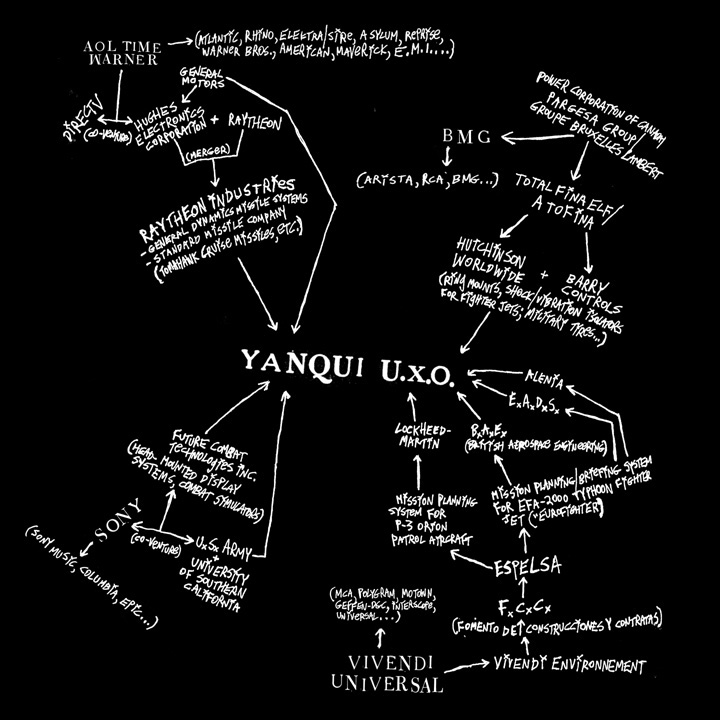
Well EMI used to make parts for nuclear weapons, a division, they made triggers or something in the 80s. But I mean I don't think a record company could afford to be in arms manufacturing anymore.
I love how disproportionate the cultural influence of the recording industry is, given how little money it makes. One oil company would make tonnes more than the entirety of the record industry.
Yeah it's like, no one worried about BP for a really long time, and you know, look what they were capable of doing once they fucked up. You know and everyone's worried about why Husker Du are on Warner Bros or something.
26.12.10
bananas

1 Drake - Over 2 Wavves - King of the Beach 3 Kanye West - Runaway (SNL performance) 4 Die Antwoord - Zef Side (YouTube version) 5 Die! Die! Die! - We Built Our Own Oppressors 6 Willow - Whip My Hair 7 Parades - Loserspeak in New Tongue 8 Otouto - W.Hillier 9 Duck Sauce - Barbara Streisand (video version) 10 Warpaint - Undertow 11 David Guetta - Memories (ft Kid Cudi) 12 Cyst Impaled - Spectral Bus 13 Crystal Castles - Empathy 14 kyu - Sunny in Splodges 15 Arcade Fire - The Suburbs
23.12.10
twenty ten ten
Things are often said better by others, so in the spirit of Yeezy's infinite guest spots and as a half-assed concession to Nick Sylvester's particularly convincing call to left things unsaid on the Internet, I've pulled a quote from others more eloquent alongside my own thoughts on each of my top albums for 2010.
10 Warpaint, The Fool
If music were vapor, Warpaint's would be a smooth, tasteless black and grey haze, clouding your latenight thoughts and sending you into a sublime stupor. This album is just the perfect concoction of mood and style, constantly aloof, perfectly crafted, sexily austere. Album highlight 'Undertow''s masterstroke is a lifted line from Cobain, "what's a matter, you hurt yourself" - though it has no debt to anyone, be it Nirvana, Interpol, Joy Division, or any others you might care to name. They simply they slide off - "open your eyes and see there's no one else".
9 Drake, Thank Me Later
On first blush I wasn't very taken with Drake's melodrama, but after overhearing 'Best I Ever Had' again recently I decided to make a return, stumbling on the perfect time and place for Drake in the process: at night, through laptop speakers. Because even though Kanye has been called the pinnacle of emo-rap or pain-pop, next to Drake, West seems like a stony ascetic. Drake's whole MO on his 2009 So Far Gone mixtape was these ambient-laced beats over digi-croons about how hard his not-gansta-but-still-rich-rapper life is. The lyrical sentiment hasn't changed much - he's just added to it with musings on how he might be thanked and remembered - but musically, his debut is much tighter, less of a drift - switching from meandering chills to properly sequenced, well constructed pop in the disguise of hip-hop. And to the extent he maintains the same woe-is-me drama and synthesises it with just really great hooks and lines, Thank Me Later deserves a thank you right now.
8 Owen Pallett, Heartland
Just like Kanye West and Drake, Owen Pallett is obsessed with thematising the act of creation itself. But whereas for Kanye this means an aesthetics of ego and for Drake a lyrical preoccupation with his own uncertainty over 'making it', for Pallett it's a far more academic affair - a bristling, lavishly adorned concept album about the fiction overcoming its creator. Or, as Pallett explaions it, "a narrative [of] one-sided dialogues with Lewis, a young, ultra-violent farmer, speaking to his creator". It's already getting crazy I know, but consider this: on the first album Pallett slaps his own name on (dropping the Final Fantasy moniker at the threat of libel, or ridicule, or both), he kills himself. Well Lewis kills him, in 'Tryst with Mephistopheles', driving an "iron spike into Owen's eyes". Triumphant, he sings:
Joanna Newsom has gone from eeking out sly but poignant little solos (The Milk-Eyed Mender), to constructing flourishing, expansive longform pieces (Ys) to something that's is kind of like a combination of the two of them - Have One On Me is like an intricate set of little rococco monuments all pieced together into something much bigger, and longer, but happy too - like a casual sprawl. There's a sense that Newsom is taking her time here, and she's asking us to do the same - by all means I'll oblige if it means that at almost every corner I get to be struck and taken along by some beautiful little gem of a moment. Everything on here just sings, a celebration of confession.
6 Die Antwoord, $O$
Many people I think would be too embarrassed put this album anywhere near their top ten for the year, what with it's ridiculously dodgey sexual politics, KLF / The Manual style genesis, and, let's face it, abundance of dud tracks - most of which were thankfully exorcised from the American release, replaced by the quite good 'In Your Face' and fucking rad 'Evil Boy'. But $O$ deserves it's place here for two reasons. The first one is pretty simple, a lot of these songs are just fucking great - sick beats and hooks, Ninja's crazy flow, how great Yo-Landi Fi$$er sounds swearing in Afrikaans. The other is just how hilarious and inspiring the whole cook-up itself is, the detail with which they went about concocting a backstory and aesthetic, not to mention the fucking commitment - Watkin Tudor Jones has literally embodied his Ninja persona, marking his body with prison tatts to complete the street look. Then there was their intensely savvy use of the internet, willingly turning themselves into a meme for everyone outside South Africa. But after the curiosity wore out, there remained some highly original and catchy music. It won't last, it's not meant to, but it was fun riding the Zef zeitgeist all the same in 2010.
5 Die! Die! Die!, Form
How is it that these three Dunedin ratbags, who tour relentlessly across Oceania, America and Europe, live barely above the dole-line when back home in their NZ hometown, and do themselves regular tineal damage at said shows (one memorable gig vocalist Andrew Wilson sung half his set head shoved in the floor-tom), manage to continually produce such brilliant albums? 2007's Promises, Promises focused their abrasive, kinetic punk ethos with an emphasis on songwriting and emotion. Form continues this combination but adds to it a new layer, heavily indebted to shoe gaze, a swirling, stormy, mood, an almost reflective patina. And it all comes to fruition on single 'We Built Our Own Oppressors', which feels like the culmination of everything Die! Die! Die! have been working towards. I listened to that track on constant repeat when it first came out, a month or two before the album, arm-hairs bristling everytime. I feared I'd drained that song's energy in those heady first days, but when Form arrived and it rolled around again I discovered that this band's well cannot run dry. There is too much life in it, sweaty, torn-up, im/mature, but it's all there, fuel for an eternal fire.
4 Parades, Foreign Tapes
This is like a dream. Where did it come from? Aching, clamouring, soaring, and above all wildly ambitious, Sydney's Parades dropped easily the most surprising and arguably the strongest debut of 2010. Like a kaleidoscope projected widescreen in a darkened theatre, this album is unambiguously joyous and beautiful, but glitters with an enigmatic magic all of it's own. Foreign Tapes is destined to take its place among the greats of Australian underground pop.
3 Crystal Castles, Crystal Castles
Crystal Castles was great, but Crystal Castles is another thing altogether! Subsuming their glitch-tics into something much more ambitious, this album is fucking transcendent. It's cloudbursts, stars glittering, beautiful. That's right, a pretty Crystal Castles album. Of course Alice Glass is still screaming away in there, there's chop cuts, but harshness here always gives way to bliss. Gauze isn't just for covering up cuts.
2 Sleigh Bells, Treats
I am 100% behind this album. You don't have to work hard to get it, in fact it's genius lies exactly in how simple, even dumb, it's idea and execution is. Literally: mix peaking hip-hop beats, ridiculously large guitars and some babe singing like a bratty yet motivational teenager to her fellow teenagers (and let's face it, we're all teenagers when we're listening to Sleigh Bells). The result: Treats - really yummy treats! Lot's of treats! It's easy, it's big, it's fun, it's also entirely unique and unrepeatable.
1 Kanye West, My Beautiful Dark Twisted Fantasy
For a long time, Kanye West redefined hip-hop, with My Beautiful Dark Twisted Fantasy, he transcends hip-hop. Not only that, he makes hip-hop transcend itself -and he does so by vacuuming everything around him, musical, political and emotional, into the centripetal force of his producer's maw. This album is unequalled in its omnivorous voraciousness, but just as much in the singularity and consistency of its aesthetic. Equally paradoxically, Kanye West is ravenous, he is all over this album, and yet at times what's most striking is that at times it's as if he's barely even there. This is the master project of the producer, the conductor, who speaks through other people's voices, verses, samples, in order to construct their art (and in the case of West, also an edifice to themselves). When he returns to his own voice, it's so often found wanting in its unadorned state, so that it's pushed through vocoders, distortion effects and so on, the recorded voice pushed beyond the limits of the 'natural' so that he might do justice to the excess that defines emotion. And yet he relents even here, knowing just one man cannot do this job (and West is exceedingly honest about his talents, his talentlessness is what fuels his talents - he recently told MTV "I do have a goal in this lifetime to be the greatest artist of all time, [but] that's very difficult being that I can't dance or sing"). So he relents, turning back to Justin Vernon to milk the sweetest, most hair-raising moment of the album for the opening of the astounding closing track. Kanye making the white-boy Auto-Tune of 'The Woods' even more impassioned. Speaking through others voices so that we all might hear what's vital. Can we get much higher?

10 Warpaint, The Fool
If music were vapor, Warpaint's would be a smooth, tasteless black and grey haze, clouding your latenight thoughts and sending you into a sublime stupor. This album is just the perfect concoction of mood and style, constantly aloof, perfectly crafted, sexily austere. Album highlight 'Undertow''s masterstroke is a lifted line from Cobain, "what's a matter, you hurt yourself" - though it has no debt to anyone, be it Nirvana, Interpol, Joy Division, or any others you might care to name. They simply they slide off - "open your eyes and see there's no one else".
And so yes, it is cosmopolitan stuff, its sexiness an entirely stately thing that is built into the very DNA of the music. If it is sexy, it does not give a fuck, in other words. -- Clayton Purdom
9 Drake, Thank Me Later
On first blush I wasn't very taken with Drake's melodrama, but after overhearing 'Best I Ever Had' again recently I decided to make a return, stumbling on the perfect time and place for Drake in the process: at night, through laptop speakers. Because even though Kanye has been called the pinnacle of emo-rap or pain-pop, next to Drake, West seems like a stony ascetic. Drake's whole MO on his 2009 So Far Gone mixtape was these ambient-laced beats over digi-croons about how hard his not-gansta-but-still-rich-rapper life is. The lyrical sentiment hasn't changed much - he's just added to it with musings on how he might be thanked and remembered - but musically, his debut is much tighter, less of a drift - switching from meandering chills to properly sequenced, well constructed pop in the disguise of hip-hop. And to the extent he maintains the same woe-is-me drama and synthesises it with just really great hooks and lines, Thank Me Later deserves a thank you right now.
@tabloidsores: Drake's a synthesis of early 00s emo-rap, the lessons of Kanye's 808s and Heartbreak and post-weezy mixtape hype
8 Owen Pallett, Heartland
Just like Kanye West and Drake, Owen Pallett is obsessed with thematising the act of creation itself. But whereas for Kanye this means an aesthetics of ego and for Drake a lyrical preoccupation with his own uncertainty over 'making it', for Pallett it's a far more academic affair - a bristling, lavishly adorned concept album about the fiction overcoming its creator. Or, as Pallett explaions it, "a narrative [of] one-sided dialogues with Lewis, a young, ultra-violent farmer, speaking to his creator". It's already getting crazy I know, but consider this: on the first album Pallett slaps his own name on (dropping the Final Fantasy moniker at the threat of libel, or ridicule, or both), he kills himself. Well Lewis kills him, in 'Tryst with Mephistopheles', driving an "iron spike into Owen's eyes". Triumphant, he sings:
I draw a bruise on your brawny shoulder,Pallett takes Roland Barthes a tad too literally here, but the irony is that he is the one doing all the killing, Lewis belongs entirely to Owen. And in the end the former cannot help but re-erect the latter, not at least given how much 'Owen Pallett' there is all over this album - brimming with his best arrangements and some of his most playful and clever moments yet. Yet that's also why this album is so great, because it works as a piece of music as much as it does as a concept. A rare union, and a joy to listen to.
Scratch my fingers over your tattoos
The author has been removed
If this all sounds too much like homework, it's worth re-reemphasizing that, whatever his protests against casual poignancy, Pallett has crafted an absorbing gem of a record, one that delivers substantial emotional payloads by means of incredibly intricate pop music. Rather than striking a blow against emotionally captivating music in favor of the album of ideas, Pallett makes a compelling case that the two need not be antagonists -- Matthew Cole7 Joanna Newsom, Have One On Me
Joanna Newsom has gone from eeking out sly but poignant little solos (The Milk-Eyed Mender), to constructing flourishing, expansive longform pieces (Ys) to something that's is kind of like a combination of the two of them - Have One On Me is like an intricate set of little rococco monuments all pieced together into something much bigger, and longer, but happy too - like a casual sprawl. There's a sense that Newsom is taking her time here, and she's asking us to do the same - by all means I'll oblige if it means that at almost every corner I get to be struck and taken along by some beautiful little gem of a moment. Everything on here just sings, a celebration of confession.
Have One One Me, in all its unprecedented Tolkienian sprawl, may be a two-hour love letter to the guy who wrote fucking “Dick in a Box.” Someone more ambitious than I will have to take on the [massive] task of analyzing that one -- David Greenwald
6 Die Antwoord, $O$
Many people I think would be too embarrassed put this album anywhere near their top ten for the year, what with it's ridiculously dodgey sexual politics, KLF / The Manual style genesis, and, let's face it, abundance of dud tracks - most of which were thankfully exorcised from the American release, replaced by the quite good 'In Your Face' and fucking rad 'Evil Boy'. But $O$ deserves it's place here for two reasons. The first one is pretty simple, a lot of these songs are just fucking great - sick beats and hooks, Ninja's crazy flow, how great Yo-Landi Fi$$er sounds swearing in Afrikaans. The other is just how hilarious and inspiring the whole cook-up itself is, the detail with which they went about concocting a backstory and aesthetic, not to mention the fucking commitment - Watkin Tudor Jones has literally embodied his Ninja persona, marking his body with prison tatts to complete the street look. Then there was their intensely savvy use of the internet, willingly turning themselves into a meme for everyone outside South Africa. But after the curiosity wore out, there remained some highly original and catchy music. It won't last, it's not meant to, but it was fun riding the Zef zeitgeist all the same in 2010.
Ek wonder hoeveel mense besef hoe ongelooflik goed hierdie musiek vervaardig is -- Johan Swarts
5 Die! Die! Die!, Form
How is it that these three Dunedin ratbags, who tour relentlessly across Oceania, America and Europe, live barely above the dole-line when back home in their NZ hometown, and do themselves regular tineal damage at said shows (one memorable gig vocalist Andrew Wilson sung half his set head shoved in the floor-tom), manage to continually produce such brilliant albums? 2007's Promises, Promises focused their abrasive, kinetic punk ethos with an emphasis on songwriting and emotion. Form continues this combination but adds to it a new layer, heavily indebted to shoe gaze, a swirling, stormy, mood, an almost reflective patina. And it all comes to fruition on single 'We Built Our Own Oppressors', which feels like the culmination of everything Die! Die! Die! have been working towards. I listened to that track on constant repeat when it first came out, a month or two before the album, arm-hairs bristling everytime. I feared I'd drained that song's energy in those heady first days, but when Form arrived and it rolled around again I discovered that this band's well cannot run dry. There is too much life in it, sweaty, torn-up, im/mature, but it's all there, fuel for an eternal fire.
Form contains a sound most unlike many other bands on the planet. Their hyperactive rhythms inspire vivid imagery of movement, of change, of progress -- Andrew McMillen
4 Parades, Foreign Tapes
This is like a dream. Where did it come from? Aching, clamouring, soaring, and above all wildly ambitious, Sydney's Parades dropped easily the most surprising and arguably the strongest debut of 2010. Like a kaleidoscope projected widescreen in a darkened theatre, this album is unambiguously joyous and beautiful, but glitters with an enigmatic magic all of it's own. Foreign Tapes is destined to take its place among the greats of Australian underground pop.
Foreign Tapes is like a carnival, a fairground in lights. It’s one of those records where magic and mirage can come true like in the Flaming Lips and the music of Iceland: colours slip and fade and explode neon again, little soft bombs of sound gently burst. Great possibilities exist, a real sense of wonder runs through it. But great drama also waits -- Chris Johnston
3 Crystal Castles, Crystal Castles
Crystal Castles was great, but Crystal Castles is another thing altogether! Subsuming their glitch-tics into something much more ambitious, this album is fucking transcendent. It's cloudbursts, stars glittering, beautiful. That's right, a pretty Crystal Castles album. Of course Alice Glass is still screaming away in there, there's chop cuts, but harshness here always gives way to bliss. Gauze isn't just for covering up cuts.
beauty and clarity -- Ian Cohen
2 Sleigh Bells, Treats
I am 100% behind this album. You don't have to work hard to get it, in fact it's genius lies exactly in how simple, even dumb, it's idea and execution is. Literally: mix peaking hip-hop beats, ridiculously large guitars and some babe singing like a bratty yet motivational teenager to her fellow teenagers (and let's face it, we're all teenagers when we're listening to Sleigh Bells). The result: Treats - really yummy treats! Lot's of treats! It's easy, it's big, it's fun, it's also entirely unique and unrepeatable.
There’s a moment [on] “A/B Machines” when a condensed, almost inhuman scream bursts through a half-second gap between guitar breakdowns. It’s a small gesture, one that seems pretty insignificant on a cursory listen, but for me this says it all: here the band has taken an intrinsically repellent sound, something universally associated with violence and pain and just general badness, and have made it enormously satisfying. And not satisfying in the sense that a lot of traditional noise music can be, nor obliquely satisfying like confrontational Dadaism. This isn’t “challenging but ultimately rewarding” ... Sleigh Bells render noise legitimately delightful. This stuff is genuinely, earnestly satisfying, in the same way all great pop music is: these songs, simply and purely, sound fucking great -- Calum Marsh
1 Kanye West, My Beautiful Dark Twisted Fantasy
For a long time, Kanye West redefined hip-hop, with My Beautiful Dark Twisted Fantasy, he transcends hip-hop. Not only that, he makes hip-hop transcend itself -and he does so by vacuuming everything around him, musical, political and emotional, into the centripetal force of his producer's maw. This album is unequalled in its omnivorous voraciousness, but just as much in the singularity and consistency of its aesthetic. Equally paradoxically, Kanye West is ravenous, he is all over this album, and yet at times what's most striking is that at times it's as if he's barely even there. This is the master project of the producer, the conductor, who speaks through other people's voices, verses, samples, in order to construct their art (and in the case of West, also an edifice to themselves). When he returns to his own voice, it's so often found wanting in its unadorned state, so that it's pushed through vocoders, distortion effects and so on, the recorded voice pushed beyond the limits of the 'natural' so that he might do justice to the excess that defines emotion. And yet he relents even here, knowing just one man cannot do this job (and West is exceedingly honest about his talents, his talentlessness is what fuels his talents - he recently told MTV "I do have a goal in this lifetime to be the greatest artist of all time, [but] that's very difficult being that I can't dance or sing"). So he relents, turning back to Justin Vernon to milk the sweetest, most hair-raising moment of the album for the opening of the astounding closing track. Kanye making the white-boy Auto-Tune of 'The Woods' even more impassioned. Speaking through others voices so that we all might hear what's vital. Can we get much higher?
Kanye West loves music. Only someone who loves music with every fiber of their being could put every fiber of every music they’ve ever loved into the music they make and have it make such ineffable sense. These six-minute bangers are haikus. Kanye West loved music better than any other artist this year and I loved his music better, too -- Chet Betz
25.11.10
lost in the world
At 23, I'm discovering what it means to be a fan. Sure, I've enjoyed various different things intensely before, but I've never had that singlemindedness that attends the fan's relationship to his object of obsession. That object, of course, being none other than the work and persona of Kanye West. I've been doing all those things a fan does with his favourite texts - endless repetition ('Kanye megamix' playlist is on constant rotation), contextual research ("what the hell is 'Chi-town'?"), continual discussion with fellow converts (happily, my housemate - with whom I watch the 'Runaway' video every couple of days with), etc.
And of course this has gotten out of control in the past week or so with the release of Yeezy's masterwork - My Beautiful Dark Twisted Fantasy. It's getting perfect scores in reviews all over the place, and I'm not sure I'd go that far, but at the least it's the most ambitious, voracious, egotistic, political and emotional thing he has done yet - and all that is saying something. I've been devouring these reviews, desperately longing to add my own voice to the tidal wave of acclaim and discussion, but up until now I simply haven't been able to muster the courage or even barest ability.
At first I thought this was because the album was so colossal, so definitive and defining of such big things - art, pop, celebrity, hip-hop, relationships, distortion - that I just wasn't up to the task. Where would one begin? How could I possibly even hope to do justice to this beast? To match up to even it's weaker moments (which it has, of course, but that's one of the things that makes Kanye so great - his brilliance and his inexactitude are mutually defining)?
(I could say many things for sure, most of them disconnected tidbits - about how the production on the album shows evidence that he just couldn't help himself, his maximalist tendencies swallowing up every possible voice and sample he could find, adding more and more even after the completely acceptable cuts of the tracks we heard on the Runaway video (the 'so high' of Dark Fantasy case in point, shoved in between another vocal itself). About it's intense black consciousness, evident at every turn, moreso than ever before in West's rapping - as a unifying thread through the album, right up to the Gil Scott Heron sample that closes it off, 'Who Will Survive in America?' About it's incessant thematising of failure, musically and lyrically - how he feeds off the fuck ups in his own story to fabricate an epic tragedy, how he pushes his voice through filters and modulators til it's past the brink of legibility, as a statement of emotion, how everything breaks down but then just builds itself up even higher on the rubble. These are all interesting points, but they are not well-made, and they have been made better by others.)
But then I realised why I couldn't talk, also why I will try again but probably fail - because that's what being a fan is. Being a fan deadens your critical faculties when it comes to the object of your fandom. 'But doesn't fandom make you want to understand more the thing?', you might argue - and of course it does, but what I've found is that this desire for understanding is matched at every point by being overwhelmed by the thing itself. Fuck it, by the music - by these songs, whose titles I just want to start typing out as if they possessed some kind of incantatory force, as if you would just feel the same way that I feel when I hear this shit. But they don't, you won't (you might?), and what one can't speak about, one must pass over in silence - and it's a kind of relief, a bliss. I've submitted myself to this album, and I'd be damned if I would even try to put into words just how this music makes me feel.
And of course this has gotten out of control in the past week or so with the release of Yeezy's masterwork - My Beautiful Dark Twisted Fantasy. It's getting perfect scores in reviews all over the place, and I'm not sure I'd go that far, but at the least it's the most ambitious, voracious, egotistic, political and emotional thing he has done yet - and all that is saying something. I've been devouring these reviews, desperately longing to add my own voice to the tidal wave of acclaim and discussion, but up until now I simply haven't been able to muster the courage or even barest ability.
At first I thought this was because the album was so colossal, so definitive and defining of such big things - art, pop, celebrity, hip-hop, relationships, distortion - that I just wasn't up to the task. Where would one begin? How could I possibly even hope to do justice to this beast? To match up to even it's weaker moments (which it has, of course, but that's one of the things that makes Kanye so great - his brilliance and his inexactitude are mutually defining)?
(I could say many things for sure, most of them disconnected tidbits - about how the production on the album shows evidence that he just couldn't help himself, his maximalist tendencies swallowing up every possible voice and sample he could find, adding more and more even after the completely acceptable cuts of the tracks we heard on the Runaway video (the 'so high' of Dark Fantasy case in point, shoved in between another vocal itself). About it's intense black consciousness, evident at every turn, moreso than ever before in West's rapping - as a unifying thread through the album, right up to the Gil Scott Heron sample that closes it off, 'Who Will Survive in America?' About it's incessant thematising of failure, musically and lyrically - how he feeds off the fuck ups in his own story to fabricate an epic tragedy, how he pushes his voice through filters and modulators til it's past the brink of legibility, as a statement of emotion, how everything breaks down but then just builds itself up even higher on the rubble. These are all interesting points, but they are not well-made, and they have been made better by others.)
But then I realised why I couldn't talk, also why I will try again but probably fail - because that's what being a fan is. Being a fan deadens your critical faculties when it comes to the object of your fandom. 'But doesn't fandom make you want to understand more the thing?', you might argue - and of course it does, but what I've found is that this desire for understanding is matched at every point by being overwhelmed by the thing itself. Fuck it, by the music - by these songs, whose titles I just want to start typing out as if they possessed some kind of incantatory force, as if you would just feel the same way that I feel when I hear this shit. But they don't, you won't (you might?), and what one can't speak about, one must pass over in silence - and it's a kind of relief, a bliss. I've submitted myself to this album, and I'd be damned if I would even try to put into words just how this music makes me feel.