6.4.11

Craig Mathieson on Authenticity

A little while ago I had a great conversation with Australian music critic Craig Mathieson to talk about the craft. Whilst it was for another project, he still had some great stuff to say and was as funny and insightful as his writing tends to be. Amongst other things he had a classic and concise take on the debates around authenticity, genres and who's footing the bill. Transcript of this section below.

What do you think of the popism and rockism debate in the US?
Well Americans came to pop music really late, and they always used to look at the British, because the British would write about anything, in their very British way, and the Americans were very unsure of pop music for a long time. It's almost an alternative badge now, in America, to be into pop - the more pop the better, you know, right down to this bizarre fetishising of Kylie or someone as being this completely authentic pop figure. Umm, well I used to fight about this when I was a kid, but I remember when people used to get upset because bands used keyboards on records. [Laughs] That's ludicrous to you probably, and it's ludicrous to me now, but you know we used to take that shit really seriously. So I don't get too bothered about it now. You know, music is more mashed up every year anyhow. But it's funny how indie attitudes and stupidity sort of hangs on, like "what's independent?" and "who should be in the AIR Awards?"

I find that stuff kind of exhausting.
It's just a sideshow. It's what's on the record in the end. I really don't care who drove the truck to the store. Unless it's paid with conflict diamonds or some shit, and I'm pretty sure Liberation's not doing that these days.

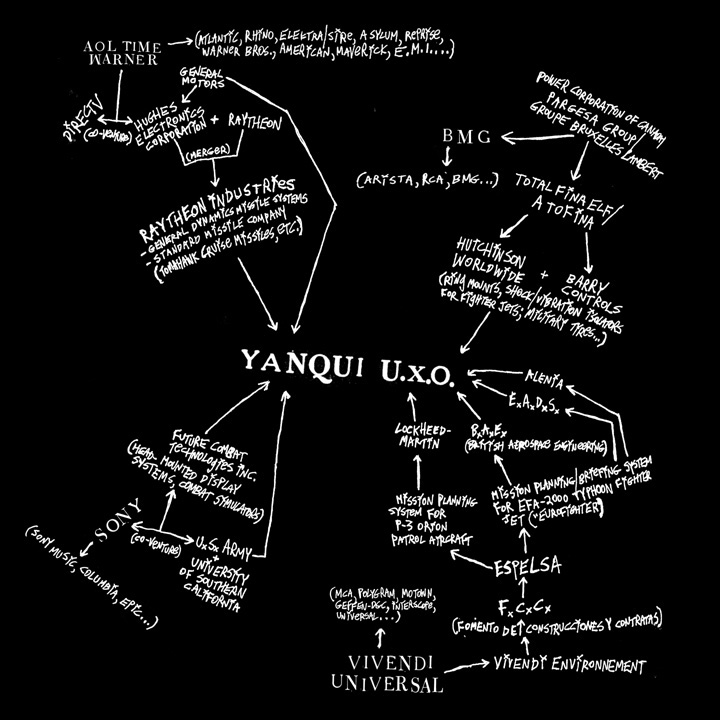
Well I remember the liner notes to Godspeed You! Black Emperor's Yanqui U.X.O had a diagram connecting major labels to arms manufacturers.
Well EMI used to make parts for nuclear weapons, a division, they made triggers or something in the 80s. But I mean I don't think a record company could afford to be in arms manufacturing anymore.

I love how disproportionate the cultural influence of the recording industry is, given how little money it makes. One oil company would make tonnes more than the entirety of the record industry.
Yeah it's like, no one worried about BP for a really long time, and you know, look what they were capable of doing once they fucked up. You know and everyone's worried about why Husker Du are on Warner Bros or something.

26.12.10

bananas


1 Drake - Over 2 Wavves - King of the Beach 3 Kanye West - Runaway (SNL performance) 4 Die Antwoord - Zef Side (YouTube version) 5 Die! Die! Die! - We Built Our Own Oppressors 6 Willow - Whip My Hair 7 Parades - Loserspeak in New Tongue 8 Otouto - W.Hillier 9 Duck Sauce - Barbara Streisand (video version) 10 Warpaint - Undertow 11 David Guetta - Memories (ft Kid Cudi) 12 Cyst Impaled - Spectral Bus 13 Crystal Castles - Empathy 14 kyu - Sunny in Splodges 15 Arcade Fire - The Suburbs

23.12.10

twenty ten ten

Things are often said better by others, so in the spirit of Yeezy's infinite guest spots and as a half-assed concession to Nick Sylvester's particularly convincing call to left things unsaid on the Internet, I've pulled a quote from others more eloquent alongside my own thoughts on each of my top albums for 2010.

10 Warpaint, The Fool
If music were vapor, Warpaint's would be a smooth, tasteless black and grey haze, clouding your latenight thoughts and sending you into a sublime stupor. This album is just the perfect concoction of mood and style, constantly aloof, perfectly crafted, sexily austere. Album highlight 'Undertow''s masterstroke is a lifted line from Cobain, "what's a matter, you hurt yourself" - though it has no debt to anyone, be it Nirvana, Interpol, Joy Division, or any others you might care to name. They simply they slide off - "open your eyes and see there's no one else".
And so yes, it is cosmopolitan stuff, its sexiness an entirely stately thing that is built into the very DNA of the music. If it is sexy, it does not give a fuck, in other words. -- Clayton Purdom

9 Drake, Thank Me Later
On first blush I wasn't very taken with Drake's melodrama, but after overhearing 'Best I Ever Had' again recently I decided to make a return, stumbling on the perfect time and place for Drake in the process: at night, through laptop speakers. Because even though Kanye has been called the pinnacle of emo-rap or pain-pop, next to Drake, West seems like a stony ascetic. Drake's whole MO on his 2009 So Far Gone mixtape was these ambient-laced beats over digi-croons about how hard his not-gansta-but-still-rich-rapper life is. The lyrical sentiment hasn't changed much - he's just added to it with musings on how he might be thanked and remembered - but musically, his debut is much tighter, less of a drift - switching from meandering chills to properly sequenced, well constructed pop in the disguise of hip-hop. And to the extent he maintains the same woe-is-me drama and synthesises it with just really great hooks and lines, Thank Me Later deserves a thank you right now.
@tabloidsores: Drake's a synthesis of early 00s emo-rap, the lessons of Kanye's 808s and Heartbreak and post-weezy mixtape hype

8 Owen Pallett, Heartland
Just like Kanye West and Drake, Owen Pallett is obsessed with thematising the act of creation itself. But whereas for Kanye this means an aesthetics of ego and for Drake a lyrical preoccupation with his own uncertainty over 'making it', for Pallett it's a far more academic affair - a bristling, lavishly adorned concept album about the fiction overcoming its creator. Or, as Pallett explaions it, "a narrative [of] one-sided dialogues with Lewis, a young, ultra-violent farmer, speaking to his creator". It's already getting crazy I know, but consider this: on the first album Pallett slaps his own name on (dropping the Final Fantasy moniker at the threat of libel, or ridicule, or both), he kills himself. Well Lewis kills him, in 'Tryst with Mephistopheles', driving an "iron spike into Owen's eyes". Triumphant, he sings:
I draw a bruise on your brawny shoulder,
Scratch my fingers over your tattoos
The author has been removed
Pallett takes Roland Barthes a tad too literally here, but the irony is that he is the one doing all the killing, Lewis belongs entirely to Owen. And in the end the former cannot help but re-erect the latter, not at least given how much 'Owen Pallett' there is all over this album - brimming with his best arrangements and some of his most playful and clever moments yet. Yet that's also why this album is so great, because it works as a piece of music as much as it does as a concept. A rare union, and a joy to listen to.
If this all sounds too much like homework, it's worth re-reemphasizing that, whatever his protests against casual poignancy, Pallett has crafted an absorbing gem of a record, one that delivers substantial emotional payloads by means of incredibly intricate pop music. Rather than striking a blow against emotionally captivating music in favor of the album of ideas, Pallett makes a compelling case that the two need not be antagonists -- Matthew Cole

7 Joanna Newsom, Have One On Me
Joanna Newsom has gone from eeking out sly but poignant little solos (The Milk-Eyed Mender), to constructing flourishing, expansive longform pieces (Ys) to something that's is kind of like a combination of the two of them - Have One On Me is like an intricate set of little rococco monuments all pieced together into something much bigger, and longer, but happy too - like a casual sprawl. There's a sense that Newsom is taking her time here, and she's asking us to do the same - by all means I'll oblige if it means that at almost every corner I get to be struck and taken along by some beautiful little gem of a moment. Everything on here just sings, a celebration of confession.
Have One One Me, in all its unprecedented Tolkienian sprawl, may be a two-hour love letter to the guy who wrote fucking “Dick in a Box.” Someone more ambitious than I will have to take on the [massive] task of analyzing that one -- David Greenwald

6 Die Antwoord, $O$
Many people I think would be too embarrassed put this album anywhere near their top ten for the year, what with it's ridiculously dodgey sexual politics, KLF / The Manual style genesis, and, let's face it, abundance of dud tracks - most of which were thankfully exorcised from the American release, replaced by the quite good 'In Your Face' and fucking rad 'Evil Boy'. But $O$ deserves it's place here for two reasons. The first one is pretty simple, a lot of these songs are just fucking great - sick beats and hooks, Ninja's crazy flow, how great Yo-Landi Fi$$er sounds swearing in Afrikaans. The other is just how hilarious and inspiring the whole cook-up itself is, the detail with which they went about concocting a backstory and aesthetic, not to mention the fucking commitment - Watkin Tudor Jones has literally embodied his Ninja persona, marking his body with prison tatts to complete the street look. Then there was their intensely savvy use of the internet, willingly turning themselves into a meme for everyone outside South Africa. But after the curiosity wore out, there remained some highly original and catchy music. It won't last, it's not meant to, but it was fun riding the Zef zeitgeist all the same in 2010.
Ek wonder hoeveel mense besef hoe ongelooflik goed hierdie musiek vervaardig is -- Johan Swarts

5 Die! Die! Die!, Form
How is it that these three Dunedin ratbags, who tour relentlessly across Oceania, America and Europe, live barely above the dole-line when back home in their NZ hometown, and do themselves regular tineal damage at said shows (one memorable gig vocalist Andrew Wilson sung half his set head shoved in the floor-tom), manage to continually produce such brilliant albums? 2007's Promises, Promises focused their abrasive, kinetic punk ethos with an emphasis on songwriting and emotion. Form continues this combination but adds to it a new layer, heavily indebted to shoe gaze, a swirling, stormy, mood, an almost reflective patina. And it all comes to fruition on single 'We Built Our Own Oppressors', which feels like the culmination of everything Die! Die! Die! have been working towards. I listened to that track on constant repeat when it first came out, a month or two before the album, arm-hairs bristling everytime. I feared I'd drained that song's energy in those heady first days, but when Form arrived and it rolled around again I discovered that this band's well cannot run dry. There is too much life in it, sweaty, torn-up, im/mature, but it's all there, fuel for an eternal fire.
Form contains a sound most unlike many other bands on the planet. Their hyperactive rhythms inspire vivid imagery of movement, of change, of progress -- Andrew McMillen

4 Parades, Foreign Tapes
This is like a dream. Where did it come from? Aching, clamouring, soaring, and above all wildly ambitious, Sydney's Parades dropped easily the most surprising and arguably the strongest debut of 2010. Like a kaleidoscope projected widescreen in a darkened theatre, this album is unambiguously joyous and beautiful, but glitters with an enigmatic magic all of it's own. Foreign Tapes is destined to take its place among the greats of Australian underground pop.
Foreign Tapes is like a carnival, a fairground in lights. It’s one of those records where magic and mirage can come true like in the Flaming Lips and the music of Iceland: colours slip and fade and explode neon again, little soft bombs of sound gently burst. Great possibilities exist, a real sense of wonder runs through it. But great drama also waits -- Chris Johnston

3 Crystal Castles, Crystal Castles
Crystal Castles was great, but Crystal Castles is another thing altogether! Subsuming their glitch-tics into something much more ambitious, this album is fucking transcendent. It's cloudbursts, stars glittering, beautiful. That's right, a pretty Crystal Castles album. Of course Alice Glass is still screaming away in there, there's chop cuts, but harshness here always gives way to bliss. Gauze isn't just for covering up cuts.
beauty and clarity -- Ian Cohen

2 Sleigh Bells, Treats
I am 100% behind this album. You don't have to work hard to get it, in fact it's genius lies exactly in how simple, even dumb, it's idea and execution is. Literally: mix peaking hip-hop beats, ridiculously large guitars and some babe singing like a bratty yet motivational teenager to her fellow teenagers (and let's face it, we're all teenagers when we're listening to Sleigh Bells). The result: Treats - really yummy treats! Lot's of treats! It's easy, it's big, it's fun, it's also entirely unique and unrepeatable.
There’s a moment [on] “A/B Machines” when a condensed, almost inhuman scream bursts through a half-second gap between guitar breakdowns. It’s a small gesture, one that seems pretty insignificant on a cursory listen, but for me this says it all: here the band has taken an intrinsically repellent sound, something universally associated with violence and pain and just general badness, and have made it enormously satisfying. And not satisfying in the sense that a lot of traditional noise music can be, nor obliquely satisfying like confrontational Dadaism. This isn’t “challenging but ultimately rewarding” ... Sleigh Bells render noise legitimately delightful. This stuff is genuinely, earnestly satisfying, in the same way all great pop music is: these songs, simply and purely, sound fucking great -- Calum Marsh

1 Kanye West, My Beautiful Dark Twisted Fantasy
For a long time, Kanye West redefined hip-hop, with My Beautiful Dark Twisted Fantasy, he transcends hip-hop. Not only that, he makes hip-hop transcend itself -and he does so by vacuuming everything around him, musical, political and emotional, into the centripetal force of his producer's maw. This album is unequalled in its omnivorous voraciousness, but just as much in the singularity and consistency of its aesthetic. Equally paradoxically, Kanye West is ravenous, he is all over this album, and yet at times what's most striking is that at times it's as if he's barely even there. This is the master project of the producer, the conductor, who speaks through other people's voices, verses, samples, in order to construct their art (and in the case of West, also an edifice to themselves). When he returns to his own voice, it's so often found wanting in its unadorned state, so that it's pushed through vocoders, distortion effects and so on, the recorded voice pushed beyond the limits of the 'natural' so that he might do justice to the excess that defines emotion. And yet he relents even here, knowing just one man cannot do this job (and West is exceedingly honest about his talents, his talentlessness is what fuels his talents - he recently told MTV "I do have a goal in this lifetime to be the greatest artist of all time, [but] that's very difficult being that I can't dance or sing"). So he relents, turning back to Justin Vernon to milk the sweetest, most hair-raising moment of the album for the opening of the astounding closing track. Kanye making the white-boy Auto-Tune of 'The Woods' even more impassioned. Speaking through others voices so that we all might hear what's vital. Can we get much higher?
Kanye West loves music. Only someone who loves music with every fiber of their being could put every fiber of every music they’ve ever loved into the music they make and have it make such ineffable sense. These six-minute bangers are haikus. Kanye West loved music better than any other artist this year and I loved his music better, too -- Chet Betz


25.11.10

lost in the world

At 23, I'm discovering what it means to be a fan. Sure, I've enjoyed various different things intensely before, but I've never had that singlemindedness that attends the fan's relationship to his object of obsession. That object, of course, being none other than the work and persona of Kanye West. I've been doing all those things a fan does with his favourite texts - endless repetition ('Kanye megamix' playlist is on constant rotation), contextual research ("what the hell is 'Chi-town'?"), continual discussion with fellow converts (happily, my housemate - with whom I watch the 'Runaway' video every couple of days with), etc.

And of course this has gotten out of control in the past week or so with the release of Yeezy's masterwork - My Beautiful Dark Twisted Fantasy. It's getting perfect scores in reviews all over the place, and I'm not sure I'd go that far, but at the least it's the most ambitious, voracious, egotistic, political and emotional thing he has done yet - and all that is saying something. I've been devouring these reviews, desperately longing to add my own voice to the tidal wave of acclaim and discussion, but up until now I simply haven't been able to muster the courage or even barest ability.

At first I thought this was because the album was so colossal, so definitive and defining of such big things - art, pop, celebrity, hip-hop, relationships, distortion - that I just wasn't up to the task. Where would one begin? How could I possibly even hope to do justice to this beast? To match up to even it's weaker moments (which it has, of course, but that's one of the things that makes Kanye so great - his brilliance and his inexactitude are mutually defining)?

(I could say many things for sure, most of them disconnected tidbits - about how the production on the album shows evidence that he just couldn't help himself, his maximalist tendencies swallowing up every possible voice and sample he could find, adding more and more even after the completely acceptable cuts of the tracks we heard on the Runaway video (the 'so high' of Dark Fantasy case in point, shoved in between another vocal itself). About it's intense black consciousness, evident at every turn, moreso than ever before in West's rapping - as a unifying thread through the album, right up to the Gil Scott Heron sample that closes it off, 'Who Will Survive in America?' About it's incessant thematising of failure, musically and lyrically - how he feeds off the fuck ups in his own story to fabricate an epic tragedy, how he pushes his voice through filters and modulators til it's past the brink of legibility, as a statement of emotion, how everything breaks down but then just builds itself up even higher on the rubble. These are all interesting points, but they are not well-made, and they have been made better by others.)

But then I realised why I couldn't talk, also why I will try again but probably fail - because that's what being a fan is. Being a fan deadens your critical faculties when it comes to the object of your fandom. 'But doesn't fandom make you want to understand more the thing?', you might argue - and of course it does, but what I've found is that this desire for understanding is matched at every point by being overwhelmed by the thing itself. Fuck it, by the music - by these songs, whose titles I just want to start typing out as if they possessed some kind of incantatory force, as if you would just feel the same way that I feel when I hear this shit. But they don't, you won't (you might?), and what one can't speak about, one must pass over in silence - and it's a kind of relief, a bliss. I've submitted myself to this album, and I'd be damned if I would even try to put into words just how this music makes me feel.

18.11.10

japan four

Ghoul - '3Mark'

This is ridiculously good. Finally this group look like living up to their name; there's a muscle and colour depth to this track that their previous recorded forays - skittish if enticing one, two minute synth scribbles and vocal snatches - lacked. One might level a 'dubstep 101' at '3Mark', but I'd argue it's offering dubstep a place to go beyond its own border, a post-dubstep if you're okay with wanky prefixes. Sure, there's the obligatory glitchy basebeat and chipmunk vocal mirror, but there's also a palpable cleanliness and determination that a lot of dubstep lacks. It's as a poppy a dubstep track that you'll ever hear in this regard, yet one that maintains the enticing schematic quality of Ghoul that always gives the song room to breathe and burrow.

There's also a sense of the arbitrary or serendipitious about it - a nonsensical title, like it was randomly culled from the lettering on the bottom of some consumer electronics item or the strings of a webpage script - a vocal hook, that never quite provides the crucial second half of its own dictum. 'Choose life, / over...', 'over...', 'over...' - the fact that Ghoul never answer their own question is an indication of the group's philosophy, their sense of experience as stochastic, of music's ability to do justice to that which cannot be worked out.

16.11.10

whoa


Finally!,… a ‘kids’ mixtape that doesn’t feature MGMT’s ‘Kids’!!!

11.10.10

a minor place

Ah, moments, those little moments in music - they are the quintessence of the art, when things come together in perfect unity, expressing an emotion, an idea, a force, in the space of seconds. Often the entry of a song into the realm of the amazing hinges on such a moment, or moments, which form a fulcrum in the flow of sound and lyric that blasts open the meaning of the composition to shine forth in glorious harmony. Sometimes, though, they are disharmonious, antagonistic - they reveal the previous lines of the song to be a kind of ruse, a ploy, a trick, and split it at the seams to bare its true meaning.

Spencer Krug, of Wolf Parade and Sunset Rubdown, has always been a man of moments; I'm sure you can name your own artists or songs whose moments just slay you. But I come to this post today thinking of a different musician and a single moment: one Bonnie 'Prince' Billy, Will Oldham, and that crucial turn in his masterful 'Hard Life', the closing track of Master and Everyone.

For the first few minutes, the song ambles along, a fairly pretty, subdued country pastiche, as Oldham and his vocal partner Marty Slayton meander through platitudes such as "And it's a hard life, for a man with no wife / Babe, it's a hard life, God makes you live" in that typically country way, where the emotion behind the lyric is one step removed from the voice itself, which remains composed. This continues, the sparse acoustic - the album itself is marked by a palpable spareness - gently strumming along.

And then it happens, around 1.59 - there is little forewarning, the bars immediately preceding have followed the established structure. But there it is, the slightest of chord changes, and the most poignant of shifts in the voice of Oldham himself, as his voice, always slightly rough, takes on an unmistakeable tenderness and sense of longing, the ends of words stretching out, as he sings:

But I ain't breathing, let me breathe
Let me go, let me leave
I don't know, but I might lose
I might bum, might blow a fuse

And then on the next verse, an electric guitar - both warm and cold in its tone (think of the same sound Oldham and Matt Sweeney achieve on Superwolf) - accompanies the acoustic, as Oldham becomes more insistent and yet somehow sadder, "So let me go, lay it down / On my own, let me drown", his voice taking on a an almost canine longing. And in a few dozen seconds, Oldham has somehow turned the mood of the universe around, and this is all the more amazing for the subtlety with which he does so. There is no hystronics or abrupt gear shifts here, just a slight tilt of the scales, a shift in the breeze, that brings with it an ocean of meaning.

1.10.10

feel right


19.9.10

from little things...

counter-anthems

Anwyn Crawford has written a piece for The Age about alternative national anthems, and her mention of the continued misinterpretation of Cold Chisel's 'Khe San' got me thinking about what you might call counter-anthems. There are quite a few instances of this in Australian pop history that I absolutely relish; songs that speak of national injustice and the dark side of the Australian condition, but that like 'Khe San' end up being received in a state of hallucination as to their actual content. I'm thinking especially of Powderfinger's 'Like A Dog', an otherwise forgettable track thick with cliches - generic 90s crunchy guitar riff, intercom vox on the bridge - that nevertheless throws some brutally pointed lines at Howard's racist treatment of Aborigines; and Presets 'My People', that confuses dance floors and detention centres, globetrotting romances with heartbreaking political exile. It's the sight of a crowded room of inebriated revellers shouting along to this last track, in particular, that always throws me.

It's not surprising either that these sorts of songs tend to be high-spirited, chorus-driven rock and dance tracks, it's as if the force of the music itself overtakes the possibility of reflection on their lyrical musings. This itself probably makes their political impact all the more powerful, in a sense, or at least more attractive from where I'm standing. Rather than the (generally) earnest, sickly prosetylising of the traditional protest song, these songs mask their true intentions behind an insistently catchy chorus or overwhelming beat; politics by stealth, massaging the subconscious perhaps, if not it in the blissfully unaware audience then hopefully at least in that undefinable thing known as the national psyche...

23.7.10

dream factory

Saw Inception last night, quite simply a brilliant, epic movie. I can't remember the last time I watched a film that captured the experience of the 'cinematic' (as opposed to the merely visual) so well, in all the aesthetic dimensions this entails. The soundtrack, with it's ominous, brass-heavy score that impresses its weight on you. The performances, in which the actors didn't really have to do much considering the scenery and narrative basically overwhelmed whatever performance they gave, but they were nevertheless lean and accomplished (plus Joseph Gordon-Levitt's star turn from teen dork (10 Things I Hate About You) to ultra-slick sidekick is inspired, perfectly cast). The plot, which is schematically complex but not so much that you're ever lost - it's spatio-temporal structure replicates the diegesis itself so at all times you know what 'level' you are on, even if Nolan can't help himself and occassionally push this question (most brilliantly, frustratingly in the final scene).

Indeed, space and time are probably the two main preoccupations of the film as a whole, thematically and stylistically. The film flips and flops between conceiving of the subconscious as a mindscape or as a series of memories and events, and beyond that as a horizontal expanse or a vertical one. Regardless, within the experience of the film itself what is most fascinating is that the audience awareness of time alternatively telescopes and dilates in the exact same way that the characters explain dreamtime - five minutes of sleep feels like an hour in a dream, and if an agent pushes into a dream within a dream time exponentially increases, and so on. This effectively replicates the effect of cinematic time and space - many have realised that sitting in a darkened theatre, immobile, with giant sound and light filling our perceptual field is quite similar in many ways to a dream state, and in the two and half hours of Inception we effectively undergo many more hours and days of experience - through the usual editing but also through the more complex editing of different temporalities in the film - the plot of most of which takes place in the few seconds it takes for a van to fall off a bridge - a slo-mo shot that Nolan periodically returns to with great relish.

In many ways, one might conceive of Inception as an allegory of the process of filmmaking itself, about which I might have more to say later, but for now, why not read a highly technical and enlightening interview with Nolan and cinematographer Wally Pfister on the making of the film:

http://www.theasc.com/ac_magazine/July2010/Inception/page1.php